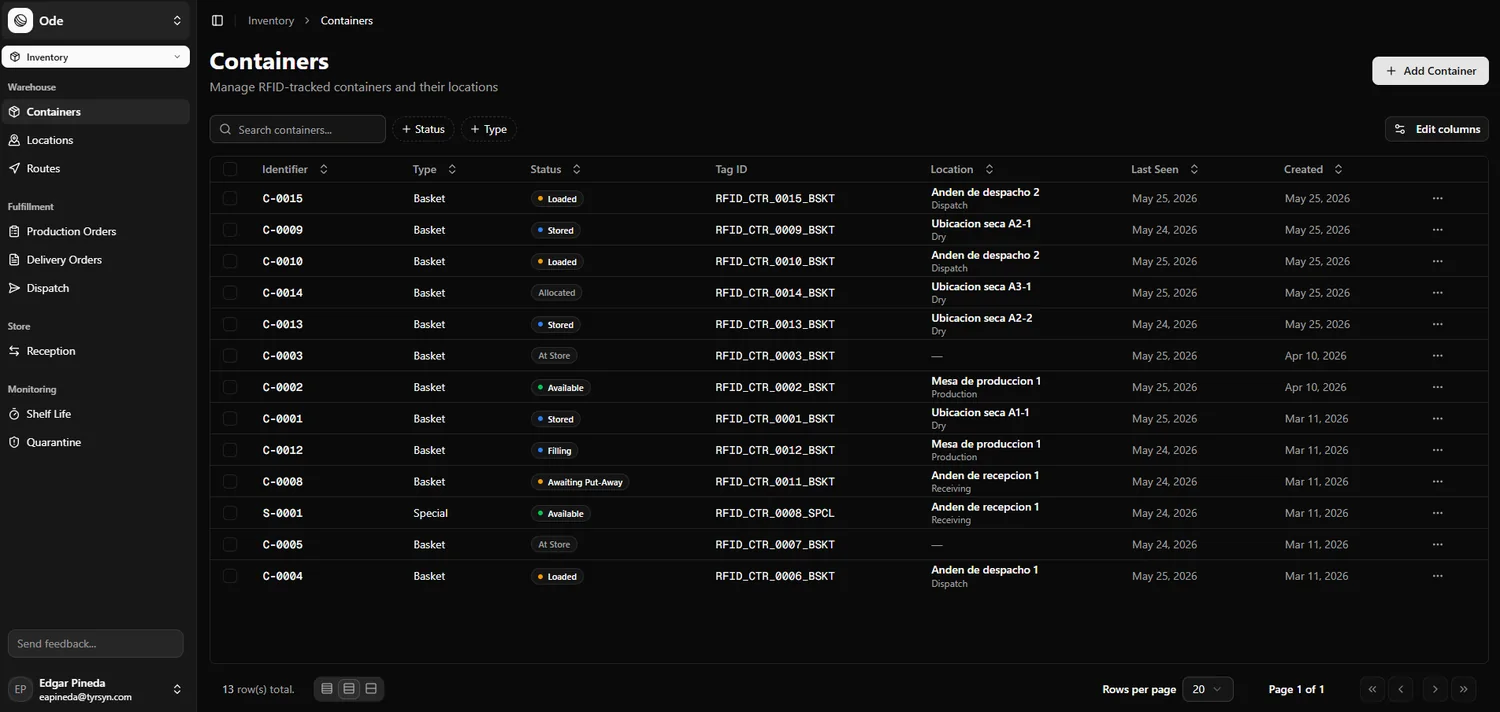
RFID hardware does one thing very well: read hundreds of tags per second, with no line of sight. But a lone read is worth nothing. The value appears when software turns each read into an event with context — and makes it available to your operation and to the systems you already use.
That control layer is Ode, our platform. It's not a generic dashboard: it's where physical reality becomes data you can query, audit and integrate, and where your RFID infrastructure stays watched. Every tracked thing —a crate, a vehicle, an asset— shows up with its status, its location and its tag.

Ode
TYR & SYN's RFID control platform. It monitors your devices in real time and turns every read into an auditable event, integrated into the systems you already use.
Every read is an event, not a number
When an antenna reads a tag, the software doesn't store «a tag was seen». It stores two distinct identifiers: the EPC —the product or unit code, which is written to the tag— and the TID, the chip's serial number burned at the factory. Plus how many times it was read, the signal strength and the exact moment.
The difference matters: the EPC can be rewritten; the TID can't. It's unique per chip and impossible to duplicate. That's why a read with a TID is evidence that that specific chip —that physical unit— was there. It's not data someone declared: it's data that was captured.
Who, when, where and against which order
Every tracked object carries its own log. For a container —a crate— the software records each movement as a timestamped event: the type (portal receiving, put-away, dispatch), the location with its zone code, the reader that saw it and the team or operator responsible. And it ties its contents: product, quantity, production date and expiration.
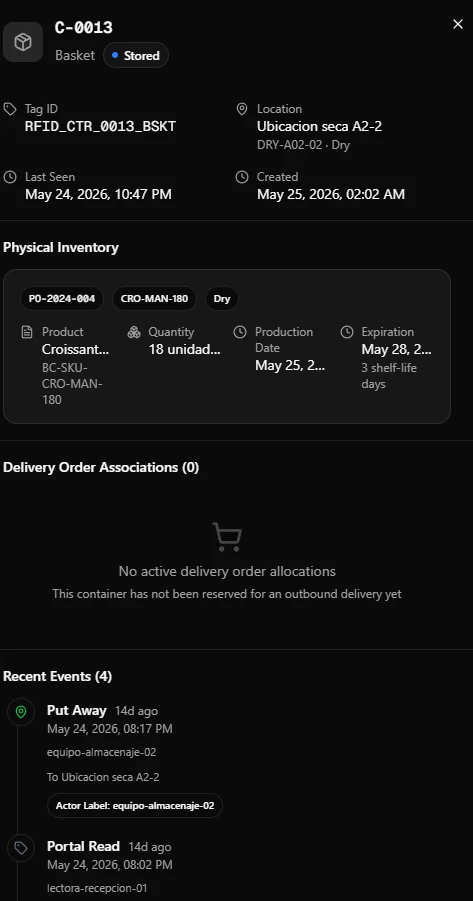
That turns «where is this and what happened to it?» into a seconds-long query with a full trail — not an investigation.
The system catches the error before it costs
When data captures itself, the software can compare what should happen against what is happening — and warn beforehand, not after. At dispatch, it validates every crate loaded onto the truck with the fixed readers: if an order doesn't match the store on that route, it flags it as a risk before the truck leaves.
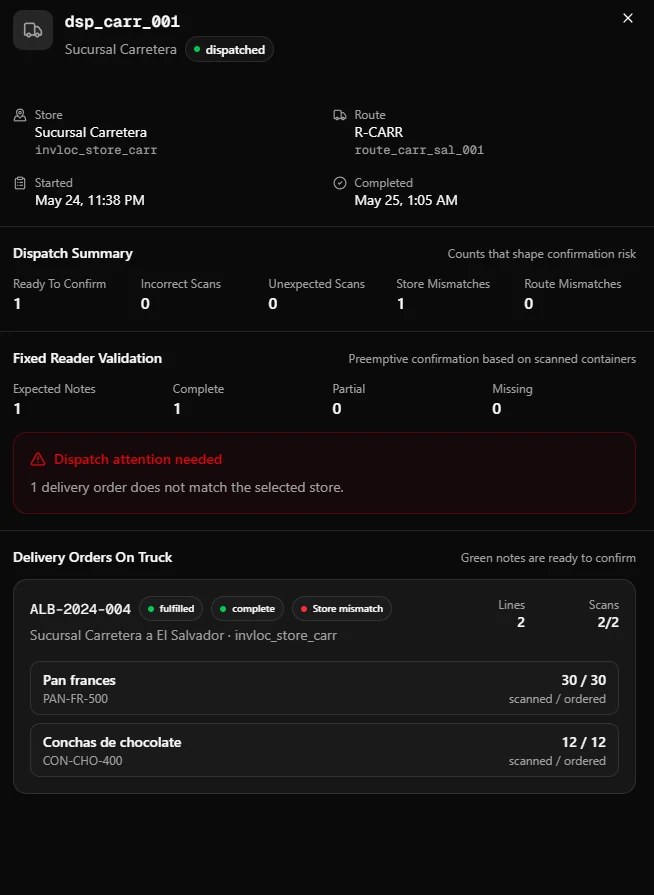
That's the leap: from finding the problem in the end-of-month reconciliation, to preventing it at the dock.
The hardware that feeds it — a single solution
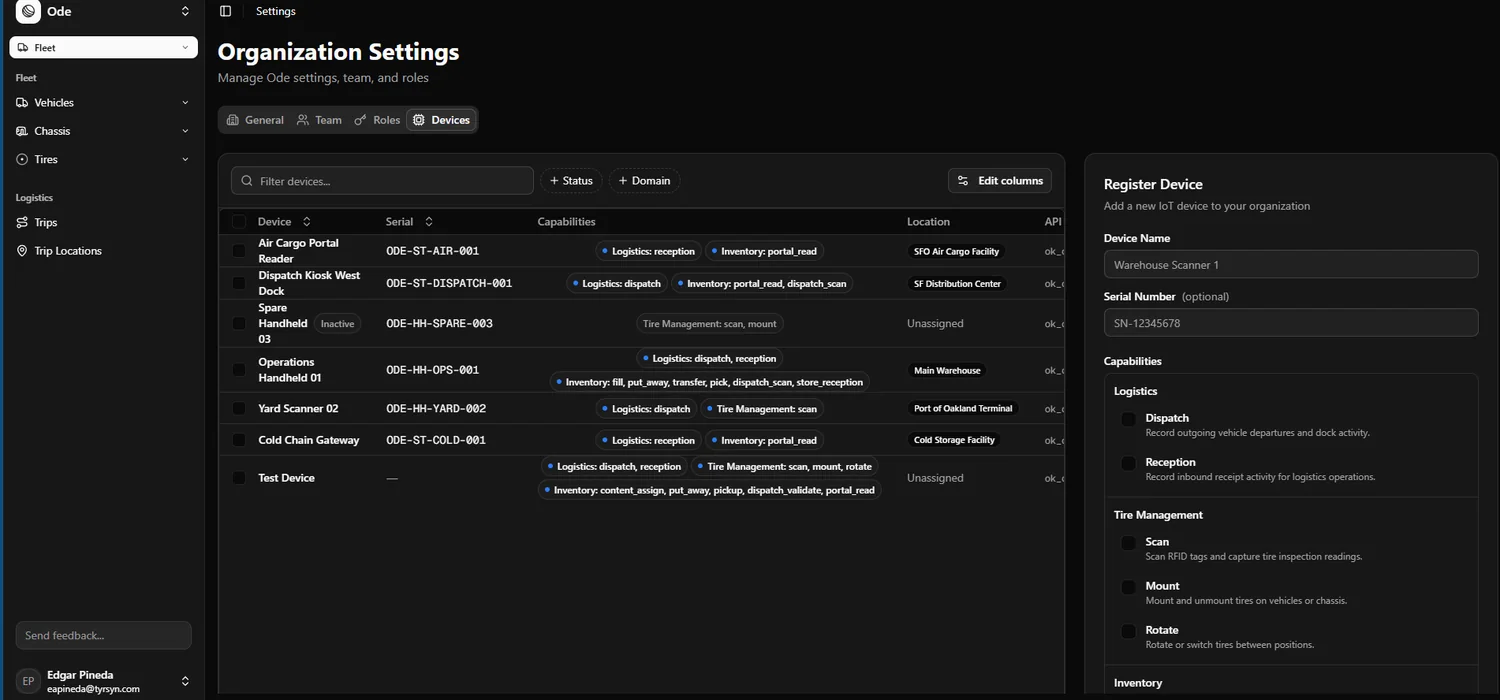
The most common mistake in an RFID project is buying readers from one vendor and software from another, and praying they understand each other. In Ode the hardware isn't an accessory: every fixed reader, portal, handheld and gateway is registered and mapped to what it does —this portal validates dispatch, this reader controls receiving, this gateway watches the cold chain—. That's why we deliver a single solution, not an integration project: the number-one risk of an RFID project disappears.
Real-time device monitoring
Ode doesn't just read tags: it watches the infrastructure that reads them. Every reader, portal and gateway reports its status live, and the platform raises health alarms when a device goes down, loses connection or stops reading —especially the fixed devices that run with no one beside them—. A dead portal is known the moment it happens, not when reads come up short at end of day.
And the platform optimizes communication between the equipment and Ode: reads travel orderly and without saturating the network, so the data arrives complete and on time even with hundreds of devices online.
Connected to what you already use
The software doesn't replace your ERP, WMS or TMS — it feeds them. Each event can be tied to a document in your operation (a production order, a delivery note), so physical capture updates your systems the moment it happens. Your systems already work; we make them see reality.
Where to start
Not with the software, but with the process. In a controlled pilot we connect reading, events and integration over one critical point of your operation, and you watch —in the platform— the real data appear on its own. With that measured, scaling is a business decision.