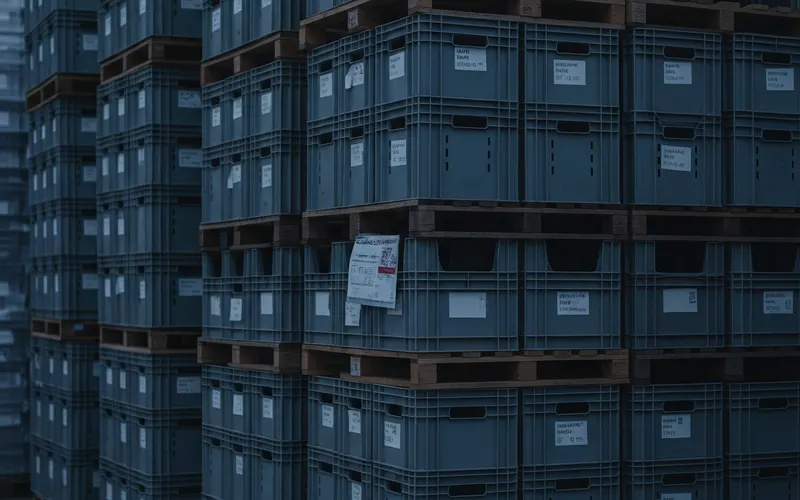
Uncomfortable question: how many crates does your operation have on the street right now? With which customer? Since when? If the answer is «approximately» — you're paying for not knowing.
The asset that leaves and doesn't come back
The returnable leaves full with the product and should come back empty. Sometimes it does. Sometimes it stays at the customer's «for now», ends up on another route, or simply disappears. Since no unit has an identity, nobody can say which one is missing or where it stayed — so the loss becomes budget: buying new returnables every year gets accepted as a normal cost of operating.
Why the spreadsheet doesn't solve it
- They move too much. Hundreds of units leave and enter every day; logging them by hand is a full-time job nobody has.
- Without identity there's no balance. «40 left, 38 came back» doesn't say which ones are missing or who has them — it only accumulates a difference nobody can charge.
- Counting at the customer's site is impossible. Your inventory is spread across dozens of locations you don't control.
How it's controlled with RFID
Each returnable carries a heavy-duty UHF tag — built for impacts, washing and weather — with a unique serial number. Read portals at the docks automatically record which units leave on each route and which ones come back. No scanning one by one, no typing.
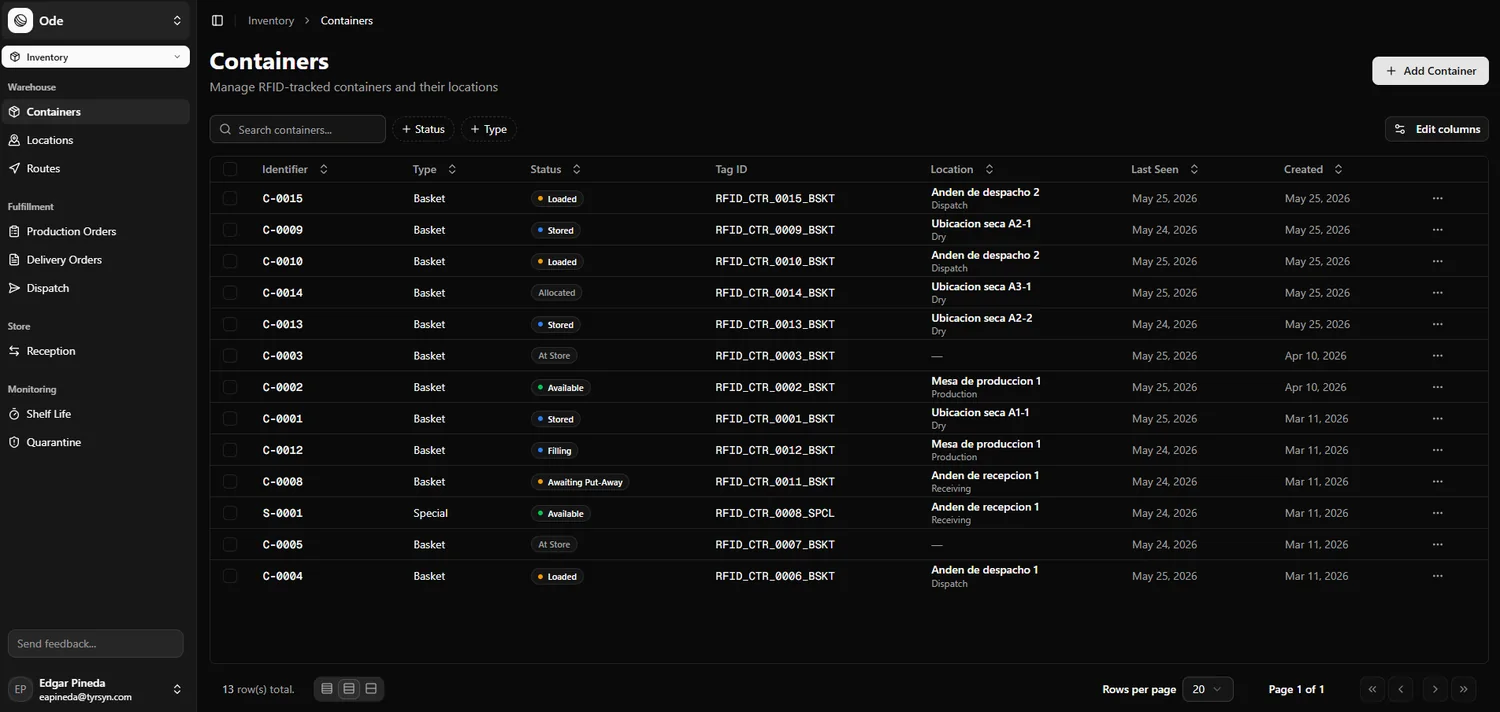
With that, the system maintains what doesn't exist today: a balance per customer and per route. These specific 40 units left to this customer; these 38 came back; units 17 and 23 are missing, for 12 days now.
That balance lives in Ode, our control platform: every crate exists as a unit with identity —its tag, its status, which customer holds it and since when— and every dispatch and return is logged as a dated event. And when the truck is loaded, the fixed readers validate each unit against the route's order: if one doesn't match, it's flagged as a risk before the truck leaves.
 Ode Every returnable as a unit: status, location and who holds it.
What changes in practice
- Shrinkage stops being a global year-end number: it's a list of units, with a responsible party and an age.
- Rotation time becomes measurable — and manageable: customers that hold, routes that lose.
- Replacement purchases are decided with data: how many units exist, how many circulate, how many were truly lost.
Where to start
With the most expensive returnable fleet or the route that loses the most. A bounded pilot — tags on a batch of units, one portal at the dock — measures in weeks whether the per-customer balance squares. Want to put a number on your case before talking to anyone? Use the savings calculator with your own returnable fleet.